The Demon Core · Volume 1
The Demon Core: A History
Introduction
This volume is a careful technical history of a single object: a 6.2-kilogram sphere of plutonium–gallium alloy, 89 millimeters in diameter, cast at Los Alamos in August 1945 to serve as the fissile pit of the third atomic bomb scheduled for use against Japan. The bomb was never built. The sphere — first nicknamed Rufus by the people who handled it, and later the demon core after it killed two of them — instead lived out its brief working life as a research artifact in the canyons of New Mexico. It killed Harry K. Daghlian Jr. on August 21, 1945, fourteen days before Japan formally surrendered. It killed Louis A. Slotin on May 30, 1946, nine days after he made the same kind of mistake. It was melted down that summer and the metal was returned to inventory, where it presumably ended up in other cores. There is no surviving piece of it.
The story is told and retold often, and is often mistold. Internet retellings confuse Daghlian’s tungsten-carbide reflector blocks with Slotin’s beryllium hemispheres, attribute the screwdriver to both men, or describe the core “going critical” when in fact it went prompt critical for a fraction of a second, twice, separated by nine months and 200 meters of mesa. The aim here is to put the technical record next to the human one, cite enough sources to let anyone check the work, and treat the deaths with the gravity they deserve.
A note on what this volume covers and what it doesn’t: the demon core was one of three cores manufactured in 1945 (the Trinity Gadget pit, the Fat Man pit, and Rufus); the design of all three is the same Christy solid-pit pattern. Where the design conversation extends beyond Rufus itself — to Philip Morrison’s magnesium carrying box, to Harold Agnew’s famous photograph at Tinian, to Robert Christy’s pit design — this volume covers the immediate context. The replica build of the core and its case is the subject of Vol 2 — Replica build.
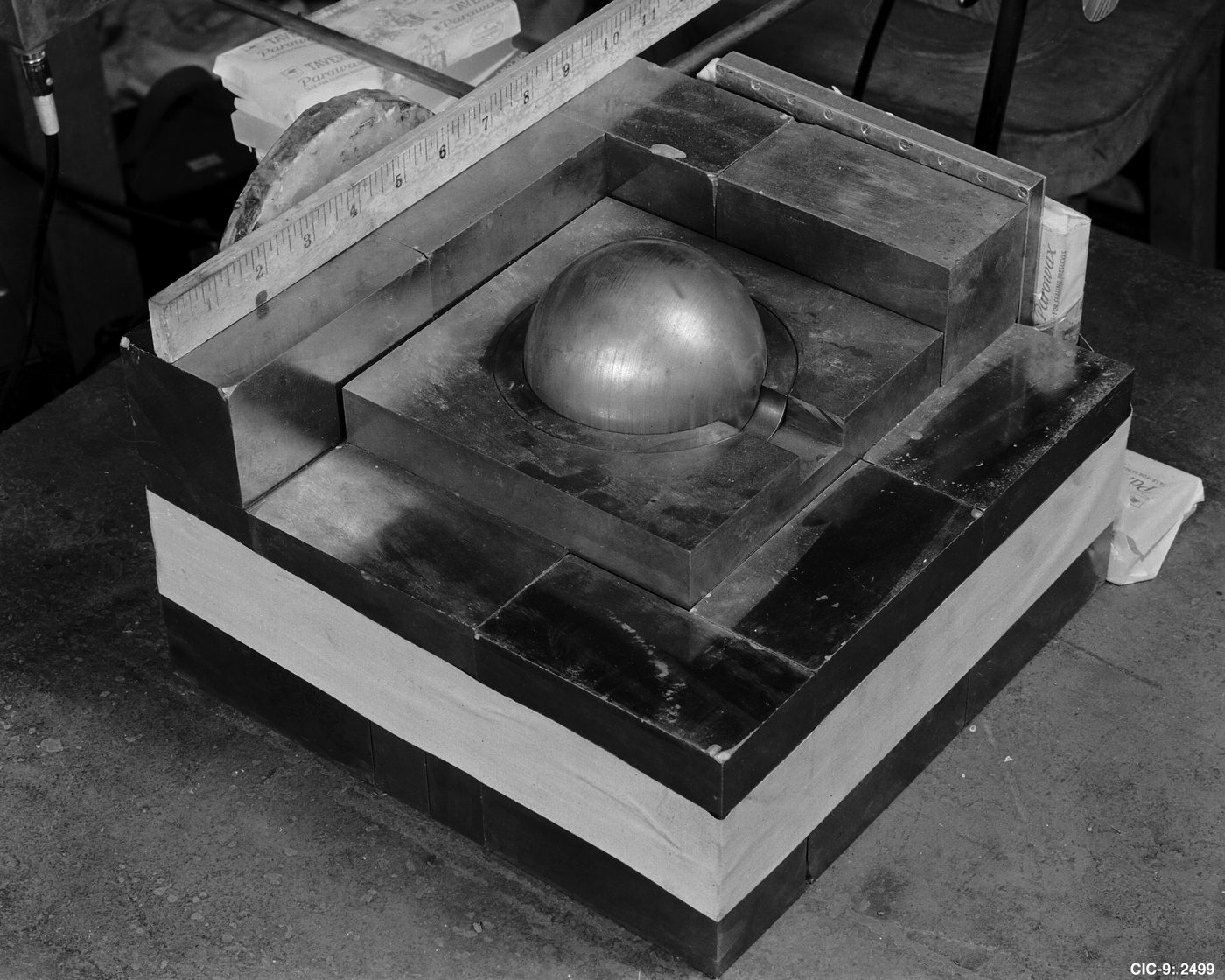
1.1 §1 Origins: the Christy pit and the third bomb
The implosion-type atomic bomb that ended the war over Nagasaki on August 9, 1945 — code name Fat Man — wrapped a softball-sized sphere of plutonium-239 in a precisely shaped explosive lens that squeezed the sphere into supercriticality. The pit itself was a Christy pit, named after the theoretician Robert Christy, who in early 1944 proposed making the pit a solid sphere rather than the hollow ring originally envisioned. A solid pit was easier to manufacture, easier to symmetrically implode at the explosive-lens tolerances available in 1945, and forgave more in the way of lens imperfection than a hollow ring would. Edward Teller had floated the solid-pit idea earlier; Christy made it practical.
The pit was 6.2 kilograms of delta-phase plutonium–gallium alloy, hot-pressed into two hemispheres of about 92 millimeters across with a 25-millimeter cavity in the middle for the polonium-beryllium “urchin” neutron initiator. The gallium — a few atomic percent — stabilized plutonium in its low-density δ phase, which would otherwise transform through a series of brittle, dimensionally chaotic α/β/γ/δ’ phases as it cooled. The hemispheres were nickel-plated to protect the operators (plutonium is pyrophoric and acutely toxic) and to keep the metal from corroding in the open air.
Three such pits were cast in 1945. The first was the Gadget pit, fired at Trinity on July 16, 1945. The second was the Fat Man pit, flown to Tinian, assembled into a bomb casing, and dropped on Nagasaki on August 9. The third — the one this volume is about — was nicknamed Rufus by the Los Alamos staff and was finished in mid-August 1945. By August 14, when Japan announced its acceptance of the Potsdam terms, Rufus was within a few days of being shipped to Tinian for a third strike scheduled for August 19 (later pushed to about August 24). President Truman halted further atomic strikes on August 10, before Rufus left the lab; by the time the surrender was signed aboard Missouri on September 2, the third pit had been redirected to research use and was sitting on a bench at the Omega Site in Pajarito Canyon, surrounded by a stack of tungsten carbide bricks. Within two weeks one of those bricks would kill the man assembling the stack.
1.2 §2 The object: what the core actually was
The core was the most expensive object per gram on the continent. Plutonium-239 in 1945 cost, by the back-of-envelope math people did at the time, on the order of half a million dollars per gram — a function of how many billions had been spent at Hanford to make a few kilograms of it. Rufus was 6,200 grams. Treat that number however you like.
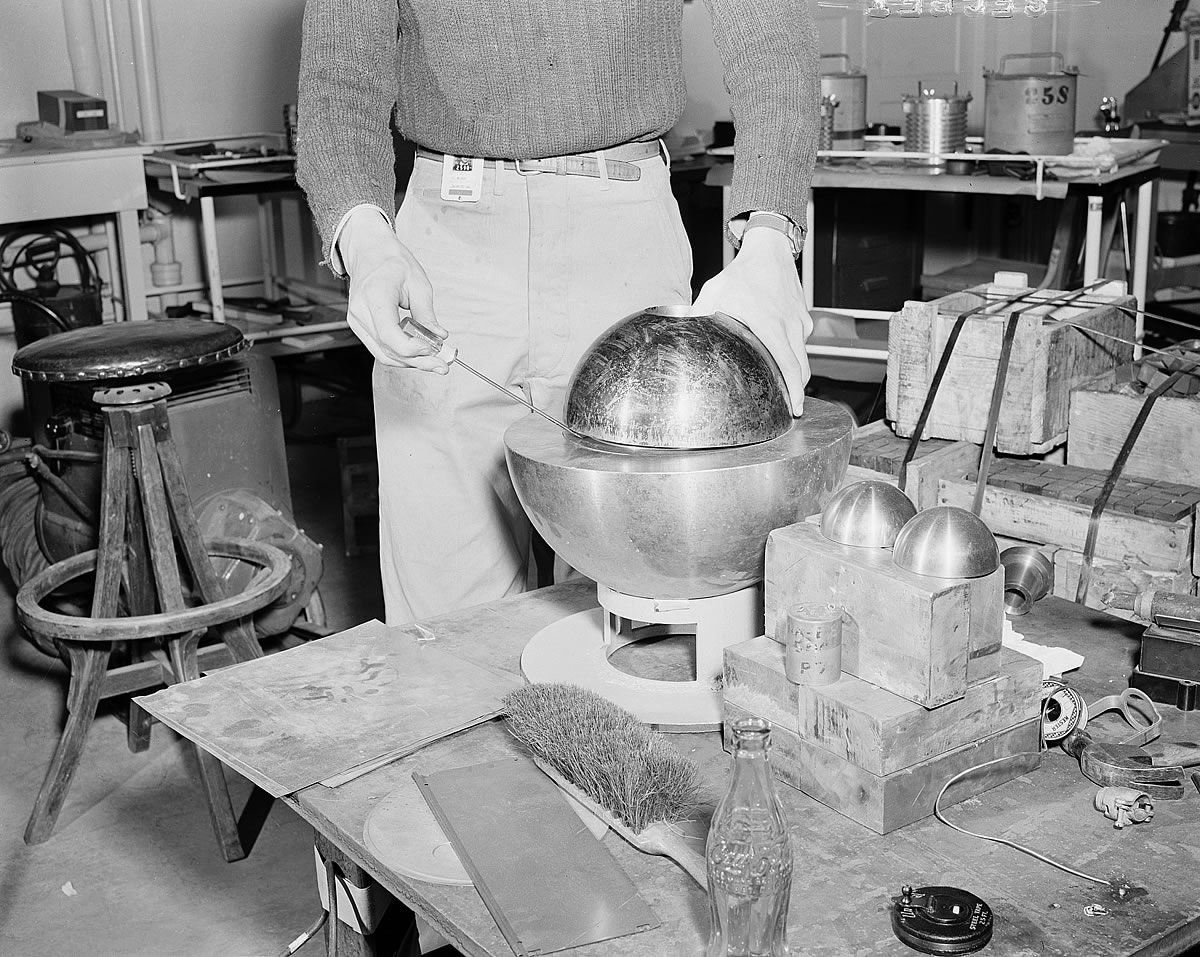
Physically it was modest. A sphere of 89 millimeters (3.5 inches) across, plated dull silver, two hemispheres bolted together around a hollow cavity meant for the initiator. The density of the alloy (~15.8 g/cm³) puts it heavier than a softball of lead and about three times as heavy as a softball of steel. It was warm to the touch — a few watts of decay heat from the Pu-239 and the small fraction of Pu-240 contamination — enough that handlers reported it felt about like a cup of hot coffee through the nickel.
The relevant piece of physics is the bare-sphere critical mass of δ-phase Pu-Ga, which is about 10 kilograms. Rufus, at 6.2 kg, was subcritical bare. Surround it with anything that reflects neutrons back into the assembly — water, tungsten carbide, beryllium, an experimenter’s tissue — and the effective critical mass drops sharply. The whole point of the criticality assemblies that killed Daghlian and Slotin was to measure, in tiny incremental steps, how close to critical you could push a known subcritical core by adding reflector material. Both men were trying to characterize the boundary. Both crossed it.
1.3 §3 The carrying box: Morrison’s design, Sparks’s hands
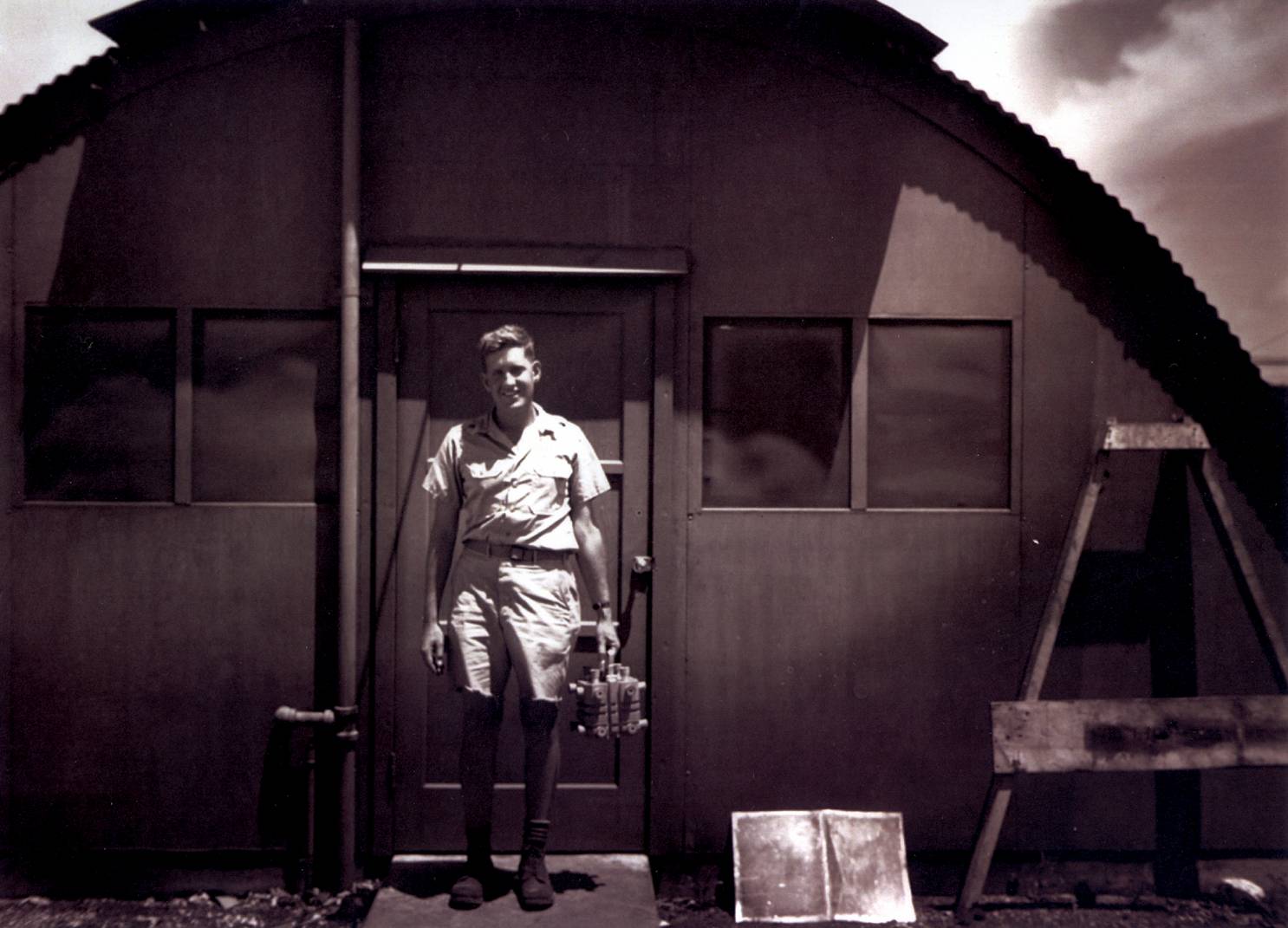
Before Rufus was a research object it was scheduled cargo. Each of the three 1945 pits travelled inside a custom-built plutonium carrying box designed by the physicist Philip Morrison — the same Morrison who would later co-host Powers of Ten with his wife Phylis — and machined at Los Alamos by Ralph C. Sparks, an Army private whose civilian trade was machinist. Sparks wrote about building the boxes in his 2000 memoir Twilight Time: A Soldier’s Role in the Manhattan Project at Los Alamos; that memoir is the cleanest first-person source on what the boxes actually were.
Morrison’s design brief had three constraints. The box had to be light enough to carry by hand — Agnew’s famous Tinian photograph shows him leaning under it, suggesting 15 pounds or so total. It had to dissipate the decay heat of the core without cooking the operators. And it had to be transparent to neutrons so that a stray reflection off the box itself couldn’t push the contents toward criticality. Morrison picked magnesium, a metal that meets all three constraints simultaneously: about a third the density of steel, conductive enough to spread heat, and with a neutron cross-section so small that the box was effectively invisible to the contents.
Construction was minimalist. The body was a magnesium shell split horizontally about a third of the way up from the bottom, with four bolts running through the top section into threaded inserts in the bottom — one at the middle of each side wall, leaving the corners free so the box could sit on its bumpers without rocking. The bumpers themselves were rubber test-tube stoppers, repurposed from the lab’s glassware supply and bolted to the four bottom corners. Inside, the core (two hemispheres for Trinity, three for Fat Man) sat in a foam-lined cradle with the polonium-beryllium initiator above it in its own slot. There were no hinges and no latches; you unbolted the four bolts, lifted the top, and the contents were right there.
Two of the three 1945 boxes survive in photographs. The Trinity box was raw, unpainted magnesium, dark grey and untreated. The Fat Man box was painted zinc-chromate yellow, the same anti-corrosion primer used on the bomb casing itself — partly so the box matched the bomb cosmetically, partly (Wellerstein speculates) for tropical-humidity protection at Tinian or to make the box conspicuous during drop-test telemetry. The third box, built for Rufus, sat at Los Alamos and never traveled overseas; the only known photograph of it is from 1946.
The most famous image of any of these boxes is the August 1945 color slide of Harold Agnew carrying the Fat Man box across the tarmac at Tinian. The FBI confiscated the slide in 1946 when Agnew was in Chicago after the war; Agnew, in his telling, joked that the contents were classified and the agents took him seriously. He negotiated to keep the slide if he scratched out the box itself with a pin. An unscratched copy of a very similar Luis Alvarez photograph later surfaced in a Los Alamos newsletter, courtesy of one Scott Carson, and it is from that image that the box’s exact yellow is now known.
1.4 §4 Daghlian, August 21, 1945
Harry Krikor Daghlian Jr. was 24 years old. He was born in Waterbury, Connecticut on May 14, 1921 to Armenian immigrant parents, started undergraduate work in mathematics at MIT, transferred to Purdue, and finished a B.S. in physics in 1942. By 1944 he was a graduate student under Marshall Holloway, work that took him to Los Alamos, where he was assigned to Otto Frisch’s Critical Assembly Group — the unit responsible for measuring the criticality properties of all the fissile material the lab worked with. The group was housed at the Omega Site (Technical Area 2), a remote building down in Pajarito Canyon, deliberately placed so that any criticality excursion would happen far from the rest of Los Alamos.
The experiment Daghlian was running on the night of August 21 was straightforward in concept. The core sat at the center of a half-built wall of tungsten carbide bricks. Each brick added to the wall reflected a few more neutrons back into the core, and the neutron-counter readout climbed accordingly. The aim was to bring the assembly close to — but never quite reaching — the prompt-critical threshold, then back off, in order to characterize the reflector’s properties. Daghlian had been doing this kind of work for months. The rules required two people present at all times.
That evening Daghlian came back to Omega after dinner to continue the day’s work alone. The only other person in the building was Private Robert J. Hemmerly, a security guard reading at a desk about ten or twelve feet away. Daghlian was placing a final brick on top of the partially assembled reflector. As his hand passed over the assembly, the neutron counter spiked — the brick, even in his hand, was bringing the system close enough to critical that he could read it on the instrument. He paused, started to withdraw the brick, and the brick slipped from his fingers and fell onto the center of the assembly.
The reflector instantly closed enough to make the core prompt critical. There was a blue flash — the ionization of air around the core by the burst of fast neutrons and gamma rays. Daghlian tried to knock the brick off with his hand. He couldn’t; his first attempt failed and he had to disassemble part of the surrounding wall to interrupt the reaction. By the time he had brought the system back under control he had absorbed what the medical reports estimated at about 200 rad of neutron and 110 rad of gamma at the body, or roughly 510 rem in total — figures vary between sources because of how the doses were modeled and converted, and the original measurements were necessarily indirect. Hemmerly, sitting at his desk, received an estimated 8 rad neutron and 0.1 rad gamma.
Daghlian walked out of the building. He drove himself to the on-site infirmary. By the time he reached the hospital his right hand — the hand that had dropped the brick — was already going numb. Over the next twenty-five days he went through the classical course of acute radiation syndrome in its hematopoietic and gastrointestinal forms: fluctuating temperature, nausea, falling blood counts, hand blistering and necrosis, mental confusion, and finally coma. His mother and sister were flown in from Connecticut. He died on September 15, 1945, and was buried at Cedar Grove Cemetery in New London.
Hemmerly survived the immediate event, was given periodic medical exams, and was reported in good health for decades. He died in 1978, age 62, of acute myelogenous leukemia. Whether the leukemia is causally attributable to the 1945 exposure is unresolved — 8 rad is a low dose, leukemia is common, and Hemmerly was a smoker — but it sits in the record next to the other long-tail mortality of the people who were near the core.
The Daghlian event was, in the literal sense, the first nuclear-reactor accident to kill a human being. The core that did it had been cast eight days earlier. It went back into the assembly room.
1.5 §5 Slotin, May 21, 1946
Louis Alexander Slotin was 35. He was born December 1, 1910 in Winnipeg, took a B.Sc. and M.Sc. at the University of Manitoba in geology, and went to England for a Ph.D. in physical chemistry from King’s College London under Arthur Allmand, finishing in 1936. He came to the Manhattan Project by way of a series of jobs in radiochemistry and biophysics; at Los Alamos his role was the closest thing the lab had to a chief armorer. Slotin assembled the Gadget pit at Trinity in the early hours of July 16, 1945, the only person Robert Bacher trusted to do it. After the war he wanted to leave Los Alamos to take a faculty position, but the lab asked him to first train his replacement, Alvin C. Graves, in the criticality experiments that the group had been running on Rufus since the previous fall.
The experiment Slotin demonstrated to Graves on the afternoon of May 21, 1946 was nicknamed “tickling the dragon’s tail” — a phrase that predates this particular setup, going back to Otto Frisch’s 1944 “dragon” experiment with a falling uranium slug at Omega. In the Slotin variant the dragon was the core itself, surrounded by two hemispherical beryllium shells. Beryllium reflects neutrons more effectively than tungsten carbide. With both hemispheres fully closed around the core, the assembly would go significantly past prompt critical. With the hemispheres separated by a few millimeters, it would not.
Slotin’s protocol — which was not the lab’s official protocol — was to hold the upper hemisphere by hand, lower it down over the core using a thumb hole, and maintain the separation with the blade of a flat-tipped screwdriver wedged in the gap. By twisting the screwdriver, he could vary the separation distance and watch the neutron count climb and fall. The official procedure required shims — small metal spacers — that would mechanically prevent the upper hemisphere from ever actually touching the lower one. Enrico Fermi, when he had seen the screwdriver method demonstrated, reportedly told Slotin that he would be “dead within a year” if he kept doing it that way. Robert Bacher had given a verbal order forbidding the screwdriver technique; Slotin had ignored it.
The room at the Pajarito Site (Technical Area 18, a different building from the Omega Site where Daghlian had died) contained seven other people that afternoon. Three were physicists with reasons to be there — Graves, who was being trained; Marion Cieslicki and Raemer Schreiber, who were watching. Two were a physics student (Samuel Allan Kline) and a Chicago-based engineer (Theodore Perlman) on a tour. One was a 54-year-old photographer (Dwight Smith Young) documenting the work. One was the security guard at the door, Private Patrick Joseph Cleary, age 21. None of the eight men in the room were standing more than about ten feet from the core.
Slotin set up the assembly with Graves about a foot and a half to his left, looking over his shoulder, and the others arrayed around the room. He lowered the upper beryllium hemisphere and engaged the screwdriver. The neutron counter began clicking faster as he opened and closed the gap. At 3:20 p.m., the screwdriver slipped outward. The upper hemisphere dropped onto the lower one.
Everyone in the room saw a blue flash. Slotin and Graves felt a wave of heat. Slotin had a sour metallic taste in his mouth and an intense burning in his left hand — the hand on the upper hemisphere. He twisted his wrist and threw the upper hemisphere onto the floor; the whole excursion had lasted, by later estimate, about half a second. He had absorbed roughly 1,000 rad of fast-neutron radiation and 114 rad of gamma, equivalent to perhaps 21 sieverts at the gut — far beyond any survivable dose. He knew it. He walked outside, vomited, and sat down on the road. He told Phil Morrison, who arrived from the lab: “Well, that does it.”
Before he left for the Los Alamos hospital, Slotin asked Graves and the others to stand exactly where they had been at the moment of the excursion. He used the chalk on the floor and a tape measure to map their positions relative to the assembly. The sketch he produced was used by the medical team to estimate everyone else’s dose by inverse-square calculation from his own — the only quantitative basis for any of their treatment.
1.6 §6 The seven who survived (for a while)
The medical and demographic record of the eight men in the room is one of the most carefully tracked epidemiological cohorts of the early atomic era. A 1951 Los Alamos report and a longer 1978 follow-up documented the doses and outcomes; the most recent re-evaluation is a 2024 Stanford physics course paper by Granowitz, which collates the modern reading of the records.
Table 1 — §6 The seven who survived (for a while)
| Person | Age in 1946 | Role | Estimated dose | Outcome |
|---|---|---|---|---|
| Louis A. Slotin | 35 | physicist (operator) | ~1,000 rad n + 114 rad γ | died May 30, 1946 (day 9) |
| Alvin C. Graves | 36 | physicist (trainee, ~1.5 ft) | ~166 rad n + 26 rad γ | survived; died 1965 of MI while skiing, age 55; had chronic neurological symptoms, cataracts, and myxedema |
| Samuel Allan Kline | 26 | physics student (visiting) | not specifically quantified | survived; died 2001, age 81; declined to participate in long-term studies |
| Marion E. Cieslicki | 23 | physicist | ~12 rad n + 4 rad γ | survived; died 1965 of acute myelocytic leukemia, age 42 |
| Dwight Smith Young | 54 | photographer | ~51 rad n + 11 rad γ | survived; died 1975 of aplastic anemia and bacterial endocarditis, age 83 |
| Raemer E. Schreiber | 36 | physicist | ~9 rad n + 3 rad γ | survived; died 1998, age 88, natural causes |
| Theodore P. Perlman | 23 | engineer (visiting) | ~7 rad n + 2 rad γ | survived; reported healthy 1978; died ~June 1988, age ~65 |
| Pvt. Patrick J. Cleary | 21 | security guard | ~33 rad n + 9 rad γ | survived; killed in action September 3, 1950, age 25, with the 8th Cavalry Regiment in Korea |
Graves is the closest comparison case: he stood directly behind Slotin and absorbed only about a sixth of Slotin’s dose because Slotin’s body shielded him. He spent weeks in the hospital, recovered, and went on to direct the U.S. weapons-test program through the 1950s. He continued to work near nuclear devices for the rest of his life. The cataracts and the thyroid dysfunction he developed are textbook late effects of acute neutron exposure. He died at 55 of a heart attack on a chairlift in Aspen.
The two whose later cancers most plausibly trace back to the accident are Cieslicki (leukemia at 42) and Young (aplastic anemia at 83). Both fell within the elevated-incidence window predicted by the dose models. The other survivors lived ordinary lifespans for their generation. Cleary, the security guard, was the youngest in the room and had the briefest life — the Korean War got him before any late effect of his 33 rad would have appeared.
1.7 §7 The dragon, and Slotin’s last days
Slotin was driven the few miles back to the Los Alamos townsite by Graves. By the time he reached the post hospital his left hand was swollen and numb; within hours both hands were blistered and a deep erythema was spreading up his arms. The lab’s chief medical officer Louis Hempelmann — who had attended Daghlian eight months earlier — took the lead on his care. Slotin’s parents were brought down from Winnipeg by Army aircraft. His vital signs held for the first few days. Then the picture changed.
By day three Slotin had severe abdominal cramps. By day five he had intermittent confusion. By day seven his bowel had begun to die back; the medical record describes intestinal paralysis, gangrene, internal bleeding, and the failure of essentially every system supported by rapidly dividing cells. He went into coma on the morning of day eight and died at 11:00 a.m. on May 30, 1946. His body was returned to Winnipeg by train; he was buried on June 2 at Shaarey Zedek Cemetery, in a coffin that had been welded shut and surrounded with sand by the Army to address the (largely theoretical) concern that his tissues had become radioactive enough to be unsafe to embalmers or pallbearers. Photographs of the funeral show his father and brother as honorary pallbearers.
The lab named the core “the demon core” sometime in the weeks that followed. The name was not official; it was a Los Alamos in-house joke that calcified into the historical record. Within a month every hands-on criticality experiment at Los Alamos was suspended. The lab spent the next two years developing the remote-controlled rigs — Godiva, Jezebel, the Honeycomb assembly — that allowed researchers to push a core toward criticality from behind a concrete wall, watching on a closed-circuit television. After 1946 no one at Los Alamos was ever in the room with a critical or near-critical fissile assembly again.
1.8 §8 The disposition: Operation Crossroads, and a quiet end
The demon core was scheduled to fly to the Pacific in June 1946 to be used as the pit of the third atomic test of Operation Crossroads, a Navy-run weapons-effects program at Bikini Atoll. Crossroads consisted of three planned tests: Able (an airdrop, July 1, 1946), Baker (an underwater detonation, July 25), and Charlie (a deep underwater detonation, originally scheduled for early 1947). Charlie was to use the recycled Rufus.
Two things stopped that. First, Slotin’s accident — the core had to sit for several weeks for its fission products to decay before it could be safely handled again. Second, the Baker shot produced unexpectedly heavy and persistent radioactive contamination of the target ships and the Bikini lagoon; the Navy could not decontaminate the target hulks well enough to send divers down for Charlie, and the test was canceled in March 1947. With Charlie canceled, Rufus had no immediate job to do.
In the summer of 1946 the lab melted the core down. The metal was returned to Hanford’s plutonium inventory, where it was reprocessed and recast into other cores. There is no surviving piece of the demon core, and no record of which subsequent device or stockpile pit (if any) ended up containing the recycled metal. The bottom hemisphere was likely recast first; the upper hemisphere, which had received the bulk of the contamination from each accident, was almost certainly held back for additional decay before reuse. None of this is documented in detail in the open literature, which is one of the small frustrations of telling the story.
1.9 §9 What changed
The Daghlian and Slotin accidents reshaped criticality-safety practice in the United States and, by extension, everywhere that did serious fissile-material work. The specific reforms — many of which were already being recommended before the second accident but not enforced — included:
- Mandatory remote-controlled assembly for any approach to critical configurations. Hands-on stacking with a live core was prohibited.
- Mandatory shims or other mechanical stops in any geometry where a single failure could close the gap between subcritical and prompt-critical states.
- A formal written protocol for each experiment, reviewed in advance by a committee that included someone other than the experimenter.
- A two-person rule for any work involving criticality-relevant quantities of fissile material.
- Quantitative dosimetry worn by anyone in the same room as such material.
The first U.S. criticality death after the reforms was at Oak Ridge in 1958 (the Y-12 accident, Cecil Kelley) — twelve years after Slotin, in a chemical-processing line rather than an assembly experiment. There has not been another in the U.S. since. The Soviet, Japanese, and Russian records contain more recent fatalities (Sarov 1997, Tokaimura 1999, Sarov 2019), each of which is the same archetypal story in a different language: a momentary lapse, a blue flash, and a few days of medical care that cannot do anything for the patient.
1.10 §10 The legacy, briefly
The demon core is a famous story now — Oppenheimer (2023) brought it back into the news; YouTube essays and meme culture have given it a second life as the “spicy rock”; the screwdriver-and-beryllium incident is a staple of every popular-science talk about radiation safety. Some of that is a fair appraisal of a strange and instructive episode. Some is closer to atrocity tourism. The cleanest framing is probably the one that the criticality-safety community itself uses: two competent men, working with an artifact that had been declared safe under one configuration, demonstrated in different ways that the configuration was not safe in the next one, and the price of demonstrating that was their lives. The reforms came at the price of their lives, and the reforms have held for the better part of eighty years.
The carrying box, by contrast, is barely remembered at all. The Morrison-designed magnesium boxes were quietly retired with the older pit geometries; later cores travelled in different containers. The Trinity box, the Fat Man box, and the Rufus box are all gone — the Trinity box was almost certainly scrapped, the Fat Man box’s fate is unknown, and the Rufus box is unaccounted for in the surviving Los Alamos property records. What remains is a handful of black-and-white and color photographs, the Sparks memoir, and a small but growing number of replicas built by hobbyists, propmakers, and Adam Savage. The replica build is the subject of Vol 2.
References
Primary historical sources
- “Demon core,” Wikipedia, accessed 2026-05-24 — https://en.wikipedia.org/wiki/Demon_core
- “Harry Daghlian,” Wikipedia, accessed 2026-05-24 — https://en.wikipedia.org/wiki/Harry_Daghlian
- “Louis Slotin,” Wikipedia, accessed 2026-05-24 — https://en.wikipedia.org/wiki/Louis_Slotin
- “Pit (nuclear weapon),” Wikipedia, accessed 2026-05-24 — https://en.wikipedia.org/wiki/Pit_(nuclear_weapon)
- Atomic Accidents, Atomic Heritage Foundation / Nuclear Museum — https://ahf.nuclearmuseum.org/ahf/history/atomic-accidents/
- Granowitz, S., “Medical Studies of the Demon Core Victims,” Stanford PH241, 2024 — http://large.stanford.edu/courses/2024/ph241/granowitz2/
The carrying box
- Wellerstein, Alex. “The plutonium box,” Restricted Data, March 28, 2014 — https://blog.nuclearsecrecy.com/2014/03/28/plutonium-box/
- Sparks, Ralph C. Twilight Time: A Soldier’s Role in the Manhattan Project at Los Alamos. Los Alamos: Los Alamos Historical Society, 2000. Internet Archive — https://archive.org/details/twilighttimesold0000spar
- “Harold Agnew carrying the plutonium core, Nagasaki Fat Man bomb, 1945,” Rare Historical Photos — https://rarehistoricalphotos.com/harold-agnew-carrying-plutonium-core-nagasaki-fat-man-bomb-1945/
Long-form reporting
- “The Story of the ‘Demon Core,’” All That’s Interesting — https://allthatsinteresting.com/demon-core
- “Demon Core: A Third Atomic Bomb Intended For Japan,” War History Online — https://www.warhistoryonline.com/war-articles/demon-core-atomic-bomb.html
- “The Chilling Story of the Demon Core,” ScienceAlert — https://www.sciencealert.com/the-chilling-story-of-the-demon-core-and-the-scientists-who-became-its-victims
Worth tracking down for a future revision
- McLaughlin, T. P. et al. A Review of Criticality Accidents (2000 Revision). Los Alamos National Laboratory report LA-13638. The canonical dose-by-dose reconstruction of every fatal and significant criticality event from 1945 onward, including Daghlian and Slotin. PDF freely available from LANL’s report archive.
- Hempelmann, L. H., Lushbaugh, C. C., and Voelz, G. L. “What Has Happened to the Survivors of the Early Los Alamos Nuclear Accidents?” Conference for Radiation Accident Preparedness, Oak Ridge, October 1979. Re-issued as LA-UR-79-2802. The primary medical-follow-up source for the surviving members of the May 1946 cohort.
- Zeilig, M. Louis Slotin and the Invisible Killer, The Beaver (1995). The single best long-form biography of Slotin in print.
Comments (0)